.png?width=2898&height=1392&name=NHH_signature_RGB_color%20(1).png "NH Housing")

Do you know how your credit score compares to other Granite Staters? The average credit score in the state of New Hampshire was 727, according to Equifax, as of March 2024.
These scores range from 300 to 850; generally, the higher the score, the stronger your credit. Higher credit scores often also lead to better loan terms, such as lower interest rates or fewer closing costs. In addition, a score above 620 is often the minimum for mortgage approval, including qualifying for New Hampshire Housing programs.
That means that if you have no credit history, are struggling with a low credit score, or are just unsure what your credit score even is, you are facing stiff competition in an already challenging housing market against more qualified borrowers.
The good news is that there are proven techniques to build up the foundation you need for success with your mortgage application. That credit score is just one important piece in a much larger puzzle of your overall creditworthiness that a mortgage lender will use when deciding whether or not to approve your application. Lenders also consider additional factors when evaluating the overall picture of you as a borrower.
Five of these criteria are especially helpful for lenders trying to predict whether you are likely to repay a mortgage responsibly. They are often referred to as the “5 C’s of Credit”. New Hampshire Housing defines these 5’Cs as the following: Credit, Capacity, Capital, Collateral, and Characteristics.
By understanding all five C’s, you not only will understand ways to build and improve your credit score, but you will also improve your overall chances of earning a stamp of approval on a mortgage application, including qualifying for programs available through New Hampshire Housing.
This guide will explain each C in detail, why each matters to a mortgage lender, and how you can be what that lender is looking for. This guide also serves as a preview to our Becoming a Homeowner course, where we dive into each of these factors in greater detail to prepare you for buying your first home in New Hampshire.
Table of Contents
Credit
Building trust through your credit history and financial behavior
When lenders think about your Credit, they are really trying to answer one question: Can you be trusted to repay what you borrow? One primary way that they answer this question is based on your credit history, which shows how you have managed debt over time.
At the heart of credit is your credit report and credit score. A credit score, as well as the larger credit report that contextualizes it, reflects your past repayment behavior, how much debt you carry, and how responsibly you’ve used credit that has been offered to you. Most mortgage lenders look at credit reports from all three major bureaus, Equifax, Experian, and TransUnion, giving a complete picture of your financial reliability.
As we already discussed, many homeownership programs, including those from New Hampshire Housing, require a minimum credit score, often around 620 for conventional programs, and completion of a homebuyer education course for first-time buyers. Even higher credit scores can also earn more favorable loan terms.
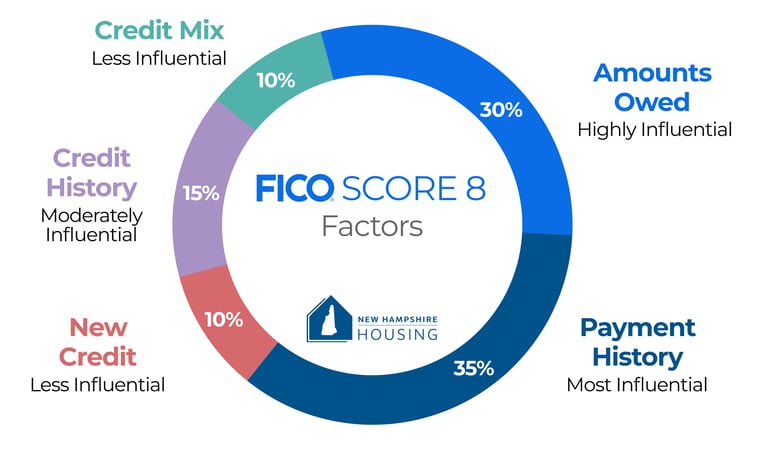
The best way to understand how to grow your credit score is to think of that number as a pie made up of different-sized slices. The size of each pie slice corresponds to how important it is to the overall score. Below are the largest pieces of that pie that can positively or negatively affect your credit score, as well as the percentage score of how much each factor affects the overall score:
- Payment History (35%): Making a payment on time every single time is the most important piece in the credit score pie. Stay ahead of any due dates and get back on track if you missed a due date, as any future late payments could affect your credit score in sequence. Do not be afraid to reach out to your lender if you think you may have to miss a payment, and ask if they have alternative methods to prevent a late payment from being reported on your credit report.
- Amounts Owed (30%): This factor is also one portion of the C of Capacity, and refers to how high your balances on revolving credit, like credit cards is compared to any credit limits. Less is more here; the more you can pay down those balances above and beyond your minimum payment, the better. Making on-time progress toward paying off other loans also increases your overall capacity, as we will see later.
- Length of Credit History (15%): Slow and steady wins the race. Long-standing accounts show stability over time, and keeping your oldest credit line open will maintain your credit history, while closed-ended loans like car payments or personal loans will eventually be closed when paid off.
- Credit Mix (10%): This is one time that multitasking is a positive thing. Having a mix of different kinds of credit, from a credit card to a car loan, to other installment loans, shows the ability to handle different credit obligations. Take caution here, though, to consider other factors in this list before thoughtfully opening additional types of credit.
- New Credit (10%): Opening new credit is not inherently bad, especially if you have not built up a sufficient credit mix to show these other factors. However, frequent new credit applications can make an applicant seem risky and can negatively affect a credit score in the short term.
- An Important Note: If you are already applying for a home loan, DO NOT open a new line of credit. That new credit inquiry can derail your application completely if the lender needs to pull your credit again, which is common. If you must put something on credit, wait until after closing on a mortgage loan.
By understanding these factors that make up a credit score, you gain insight into how a mortgage lender is using the whole credit report to evaluate your credit as a borrower. That higher score often translates into better interest rates and easier approvals, so it is well worth your time and attention.
You are the person primarily responsible for the accuracy of this information, so we recommend reviewing each credit report at least once a year. You should also review credit reports from all three credit bureaus for any discrepancies, as they don’t share all information. Thanks to the Fair Credit Reporting Act, or FACTA, you can get free credit reports from each agency by going to www.annualcreditreport.com or by calling (877) 322-8228.
Now that you understand credit and what shapes it, it is time to delve deeper into your capacity to pay on a future mortgage loan.
Capacity
Demonstrating you can afford the monthly mortgage payment
Once lenders feel comfortable with your financial history, they look more closely at your Capacity, your ability to repay the loan based on your income and existing debt.
Capacity is measured using ratios that compare how much you owe each month to how much you earn. A key ratio lenders review is your debt-to-income (DTI) ratio, which includes the sum of your payments across the mortgage applied for, and any car loans, credit cards, student loans, and other recurring obligations, divided by your gross monthly income. The lower this percentage, the more confident a lender can be that you can manage the additional mortgage payment.
The income side of the DTI ratio is also evaluated in terms of stability. For many loans, including FHA, USDA, VA, and conventional loans, lenders typically require steady income, ideally at least two years with the same employer or consistent self-employment history. If employment includes seasonal work or self-employment in small businesses, clear documentation and accurate income statements will matter.
Because capacity is tied to that income stability, job changes during the mortgage process can slow things down. If your income recently changed, be prepared to explain it to your lender. Being upfront and organized helps keep your application on track.
This part of the process is where understanding your budget, both before and during your mortgage application, pays its own dividends and is exactly the type of financial foundation the Becoming a Homeowner course helps you build.

Capital
The funds you bring to the purchase
Your Capital is the money you have available to put toward buying a home. This includes your down payment, closing costs, and reserves for future expenses.
In New Hampshire, many mortgage programs help reduce the upfront financial burden, including cash assistance of up to $15,000 for downpayment and closing costs through New Hampshire Housing’s programs. But regardless of assistance, lenders want to see that you have skin in the game, whether by putting money down or showing the discipline to hold the necessary savings.
Capital matters for two reasons:
- It reduces the lender’s risk by lowering the amount they must lend you.
- It demonstrates that you can manage your finances, which supports the rest of your application and speaks to the C of character.
Different loan types have different expectations for minimum downpayments, for example:
- FHA loans may allow as little as 3.5% down with flexible credit requirements.
- VA loans may not require a downpayment for eligible service members and veterans.
Saving money to raise the necessary capital takes time, but it also strengthens your application and builds your confidence as a homeowner. The Becoming a Homeowner course covers how to build this savings strategy step by step.
Collateral
The property that secures the loan
The mortgage itself is secured by the home you are buying; that’s what Collateral means. If you were unable to repay the loan, the lender could take possession of the property to recoup their investment.
Before closing, an appraisal will be ordered to determine the home’s value. The appraisal ensures that the sales price matches the home’s actual market value and confirms that the home meets basic safety and livability standards.
In New Hampshire’s diverse housing market, from historic neighborhoods in Portsmouth and Concord to rural properties in the North Country, property types and conditions vary widely. A strong appraisal protects both you and your lender.
It’s important to know:
- An appraisal is not the same as a home inspection. A home appraisal determines a property's market value for the lender, sometimes without an on-site visit, while a home inspection evaluates the home's physical condition for the buyer.
- Homes with major safety or health issues may require repairs by the lender as a condition before closing.
- Location, home condition, and comparable sales near your property all influence the appraisal and potential conditions on a loan. For example, if the home is located in a flood zone, the purchase of flood insurance may be required.
Preparing for the collateral evaluation of the property you are hoping to make a home helps you avoid surprises and keeps the loan process moving.
Characteristics
External factors that can influence your loan
Finally, lenders look at Characteristics, additional external, and loan-specific factors that can affect your ability to repay.
Characteristics include, but are not limited to:
- The current economic climate, including whether interest rates are expected to rise or fall.
- Job market trends when considering your income sources.
- The loan type selected and its terms, including changes to government policies affecting loan types such as FHA, USDA, or VA.
- How you plan to use the loan, such as if you plan to use the home only as a primary residence, or intend to collect rental income.
Although characteristics are often outside your direct control, understanding them helps you make decisions such as locking in an interest rate, choosing a loan type (FHA, USDA, VA, or conventional), or timing your purchase.
For example, rising interest rates can increase monthly payments if you are not locked into a fixed-rate mortgage product. A strong understanding of characteristics helps you make informed decisions and choose loan options that align with your financial goals.
Pulling it All Together
No single “C” stands alone; mortgage lenders weigh all five together to decide your overall creditworthiness. Strength in one area can help offset a weakness in another, but the strongest applications demonstrate preparedness across all five: Credit, Capacity, Capital, Collateral, and Characteristics.
For first-time buyers in New Hampshire, this means knowing your credit well, understanding income requirements, saving for a downpayment, choosing properties wisely based on the local market, and staying informed about broader economic conditions.
New Hampshire Housing’s Becoming a Homeowner online course takes these principles and walks you through what they look like in far greater detail, with local context, New Hampshire program guidance, and exercises that help you prepare every part of your mortgage application.
Whether you are just starting to think about buying a home or you’re ready to apply for a mortgage, understanding the 5 C’s of credit sets you up with the foundation for mortgage success.



Sign up for New Hampshire housing’s email list today for the latest events, news, and offers.